
By New Zealand specialists James, Sara-Jane, Allison, Alison and Bianca
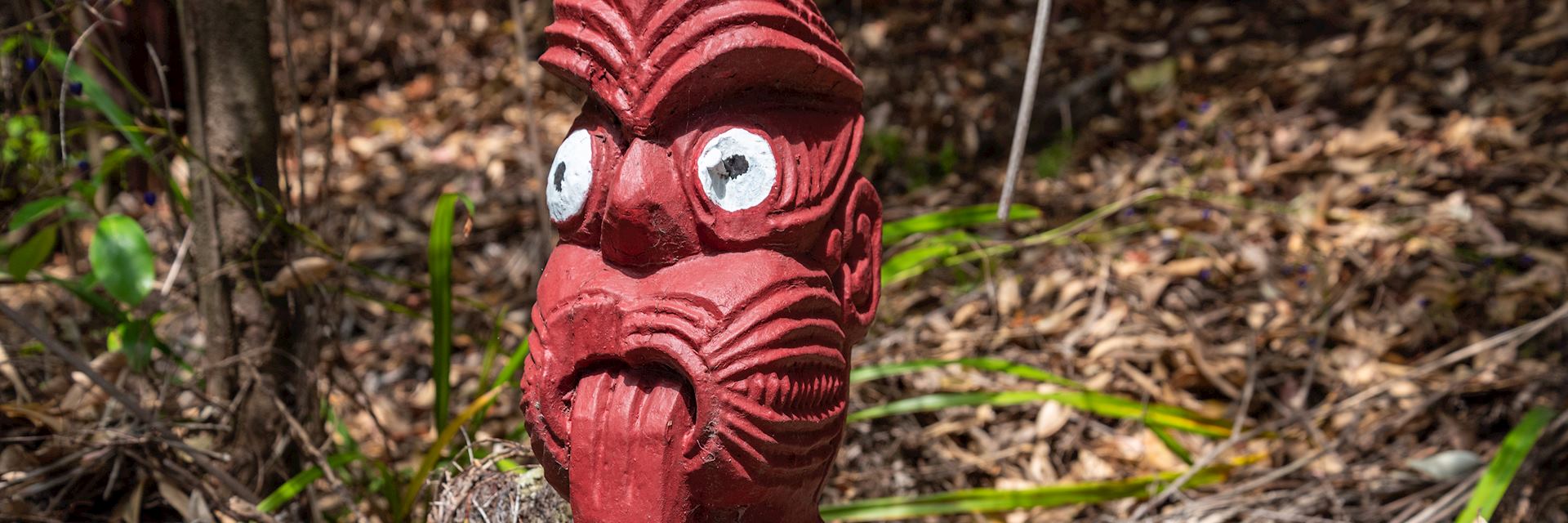
New Zealand’s Māori heritage is intrinsic to its identity. Compared with, say, Canada’s First Nations people or Australia’s Aboriginals, Māori culture is proudly prominent and coexists peaceably with Pakeha (white New Zealander) life. And, yet, you could easily visit New Zealand without ever coming into contact with Māori in a non-touristy way.
In this guide, our specialists talk about the experiences that have allowed them to get a better understanding of Māori culture while visiting New Zealand ― and you can take part in all of them on a trip to the country.
If you’re very interested in the Māori, you could choose to focus your time on the North Island, where the vast majority of these experiences take place (and where most Māori live). But you could also venture to the South Island’s Kaikoura for a completely different take on a town known mainly for its marine life.
Waipoua Forest Twilight Encounter, Northland
By James
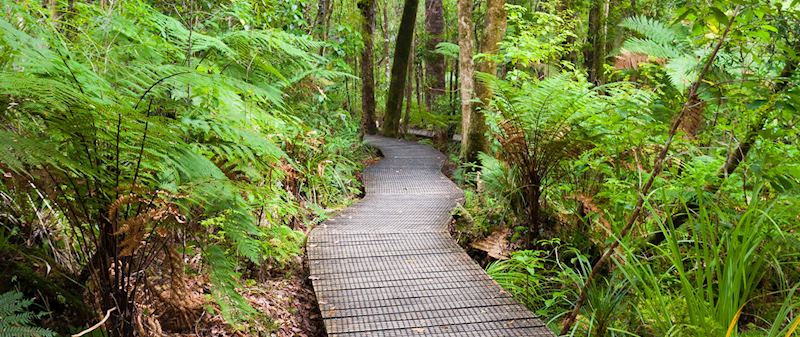
The Waipoua Forest feels alive. Frothy nikau and rimu palms twitch in the light evening breeze; bundles of crown ferns shiver. Nearby, a pupurangi — a carnivorous snail — oozes out of its shell and slurps up an unsuspecting toke worm. The call of the ruru owl clatters through the darkening understorey. I listen out for the shrill cry of a male kiwi, while peering through the trees in search of glow-worms. Come nightfall, they turn something as ordinary as a mossy trunk into a miniature citadel of a thousand lights.
Not that there’s anything ordinary about this expanse of virgin native forest. Before we enter its depths, my Māori guide, Merepaea, takes me to a lookout over Hokianga Harbour. The setting sun throws a dusky pink wash over the landscape.
We pad softly along on a raised boardwalk. She tells me how, in Māori legend, Mother Earth and Father Sky were pushed apart by their offspring, the trees, and how the trees’ seeds in turn were consumed by animals. The kiwi was nominated protector to the fledgling trees and for this act of service, say the Māori, it lost its ability to fly.
We approach a weighty tree with distinctive white-grey bark — it’s a kauri (pronounced ko-dee), a species of endemic giant conifer that once covered much of Northland and the Coromandel Peninsula. Merepaea points to resin seeping between its flaking, scale-like bark, which acts as a recovery mechanism.
It’s a reminder of how fragile these trees are. Extensively logged by European settlers to New Zealand, they’re now suffering from kauri dieback disease. Merepaea’s voice quivers a little as she tells me this. The specimen towers above my head, but she assures me it’s, ‘only a seedling’. For her, this forest is a sentient being and kauris are ‘the gods of the forest’.
We continue on the boardwalk, and she begins to sing plaintive, sacred chants in Te Reo, the Māori language. The hairs on the back of my neck stand up.
We come to an opening in the canopy. Suddenly, he’s there before me, a tree whose girth is so vast it makes my arm span seem puny. This is Te Matua Ngahere (‘Father of the Forest’), the oldest kauri in New Zealand at 3,500 years old.
His trunk swells into a cup-like bulge about three quarters of the way up, and in places it sprouts with the trunks of younger trees hitch-hiking on his bulk. Finally, Merepaea takes me to view Tane Mahuta (‘Lord of the Forest’). He indeed lords it above the treeline at 51 m (167 ft) high. Framed by a backdrop of piercingly clear stars, his whitish trunk glows even brighter.
Behind the scenes at Te Papa Tongarewa, Wellington
By Sara-Jane
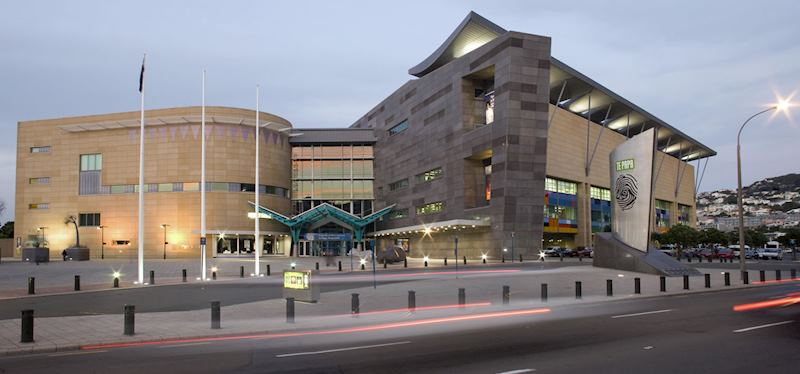
How many museums require you to remove your shoes before entering? Then observe a Māori prayer? But Te Papa, New Zealand’s national museum, isn’t your average institution.
Here, you can opt to venture quite literally behind-the-scenes, passing through an inconspicuous door into the hidden corridors of the Māori collections. Most of the objects kept here are never on public display.
I felt a bit like Alice down the rabbit hole as Lisa — herself Māori, and the collections’ creator — took me through room after room of curiouser and curiouser objects. Drawer after drawer of immaculately preserved chiefs’ cloaks individually handwoven with downy kiwi feathers. Rows of spears lined up like oars. Elaborately carved wooden masks, and even a mass of everyday eating utensils and tools in a conglomerate stack.
The full Māori name for the museum — Te Papa Tongarewa — gives you a much better sense of its importance. It translates rather lyrically to, ‘our container of treasured things and people that spring from Mother Earth here in New Zealand’.
I watched as Lisa handled each object with reverence and yet also a warm familiarity. She knew them like old friends and all their (sometimes grisly) histories, such as which patu (club) had been used to finish off which distinguished chief. It gave me an appreciation not only of the warrior identity that’s essential to understanding the Māori, but also a deep respect for their craftsmanship.
Rotorua’s meeting houses… and a Māori church
By Allison
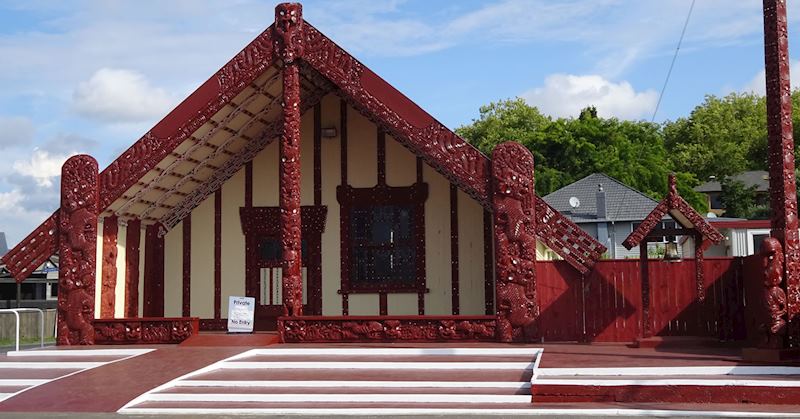
Māori meeting houses are gingerbread-cottage-resembling wooden buildings, often painted in maroon or oxblood red, and decorated throughout with stylistic carvings of a tribe’s ancestors. Their design recalls a human body. The diagonal bargeboards represent the arms and hands, the ridge beam the backbone, the rafters the ribs and the central pole the heart.
If you’re spending time on New Zealand’s North Island, you’re likely to see several of them. Non-Māori are rarely allowed to enter, and so to me they’d always seemed slightly forbidding, esoteric places.
But, I recently had the chance to visit a private meeting house that belongs to one of the most well-known Māori families in Rotorua. They can be grand, high-ceilinged constructions, but this one was so unassuming you could easily have walked past it on the street.
Most meeting houses are empty spaces, but my host, Renee, showed me how her family would store their most precious relics inside. She pointed out carvings, weavings, and even photographs of her great-grandmother — a former celebrated tour guide — meeting Queen Elizabeth II and Eleanor Roosevelt.
After exploring the intricacies of the meeting house, I was welcomed into the home of an older couple, Josie and Willie. Here, I had a lesson in crafting the pom-pom-like poi balls used in dance performances by wahine (female dancers), created by attaching spherical weights to flaxen strings.
We then wandered a short way down to the lakefront. Here, amid the odd steaming vent and a military graveyard of white sarcophagi (the town’s rampant geothermal activity precludes underground burials) stands Saint Faith’s Anglican Church. This faux-Tudor red-and-cream concoction was built by the town’s Māori community in 1910, and Josie and Willie explained that they were now its caretakers.
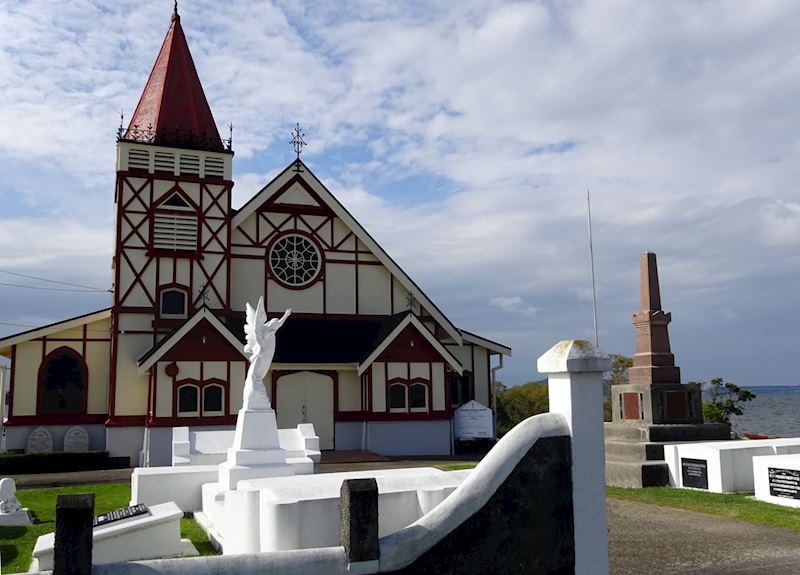
Inside, it’s a vivid, Māori-infused interpretation of a traditional Anglican interior. The pews are bookended with elaborate tribal carvings, while tukutuku (ornamental latticework) and woven wall hangings embellish the nave.
Most interesting of all is the etched-glass window in a chapel in the right-hand corner of the church, which pictures Christ wearing a traditional Māori chief’s cloak. If you sit on the pews directly in front of the window, it looks like he’s walking on the waters of Lake Rotorua.
Directly opposite the church stands the slightly older (c. 1873) rust-red Tamatekapua Meeting House, its façade swimming with goggle-eyed carvings of ancestors of the local Arawa tribe. They stare across at the church in what looks like a face-off, but really the proximity of these buildings is a great example of New Zealand’s biculturalism. ‘Do you still use the meeting house?’ I asked Josie. ‘Oh, all the time,’ she replied. ‘For ceremonies — we went just last week to remember an older member who’s passed away — but also to talk about business.’
Paddling a waka and dining with a Māori family, Rotorua
By Bianca
Rotorua may be a major hub for New Zealand’s Māori community, but it can also feel a little like a theme park. While visits to recreated Māori villages, hangi (traditional feast) dinners, and song and dance performances are enjoyable, there’s a bit of a barrier between guests and performers and it can leave you wanting to know more about the actuality of modern-day Māori life. That’s the beauty of this experience.
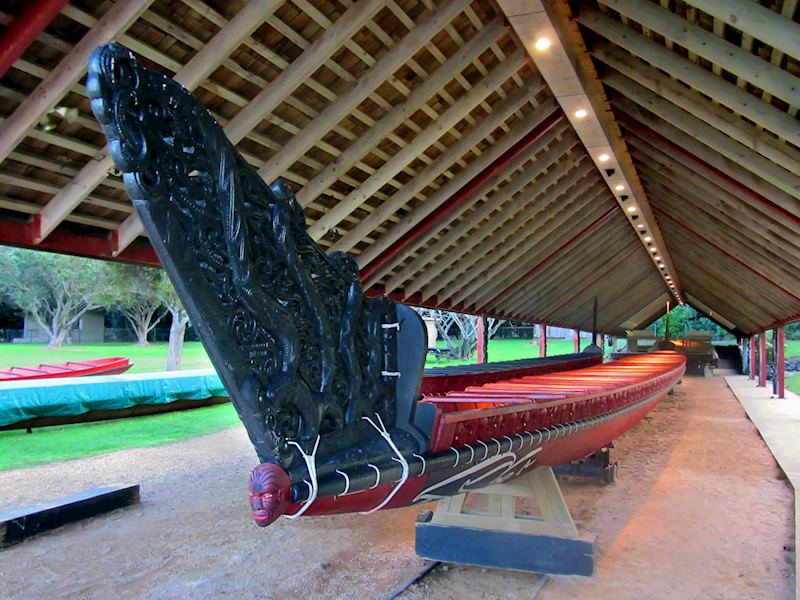
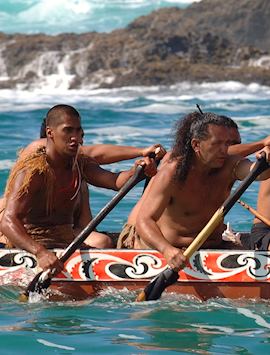
First lesson of the day: paddling a waka (traditional Māori wooden canoe) is damn hard. My lesson in this sport began on Rotorua’s blustery lakefront with an instructor, Warner Rahurahu, who’d competed internationally in waka racing.
He psyched our small group up by introducing us to traditional chants and demonstrating different paddling techniques. Then we launched the boat, and began to paddle across the choppy waters, listening for Warner's commands while he coxed at the stern. I may not ever make a Māori warrior, but it was fun to try my hand at it.
Talking of bona-fide Māori warriors (of sorts), afterwards I headed for dinner at the home of Jim Love, a former All-Blacks player and coach. Now, you might think it would be awkward sharing a meal in the home of someone you have never met. But Jim and his family couldn’t have been more welcoming, a real testament to the Māori tenet of manaakitanga (hospitality).
I enjoyed a pre-dinner soak in the family’s geothermally fuelled hot tub (glass of wine in hand) before we sat down to a hearty dinner of lamb, potatoes and root vegetables. Originally, Jim told us, the Māori would have cooked this meal in a heated pit in the ground.
As we relaxed, I felt able to ask Jim and his family more and more questions about aspects of Māori culture. We soon got into in-depth conversations about everything from the Māoris’ connection to the earth to how totem poles commemorate a family or tribe’s protectors and how traditional healing skills are sadly dying out.
But cultural preservation is making strides in other areas, the family explained. There’s now a school in Rotorua dedicated to teaching the arts of carving and weaving, and Jim has founded a sports foundation aimed at local Māori children. ‘They’re natural athletes, naturally gifted,’ he told me, ‘They just need an opportunity to develop their skills.'
Spending time with a Māori family in Kaikoura
By Alison
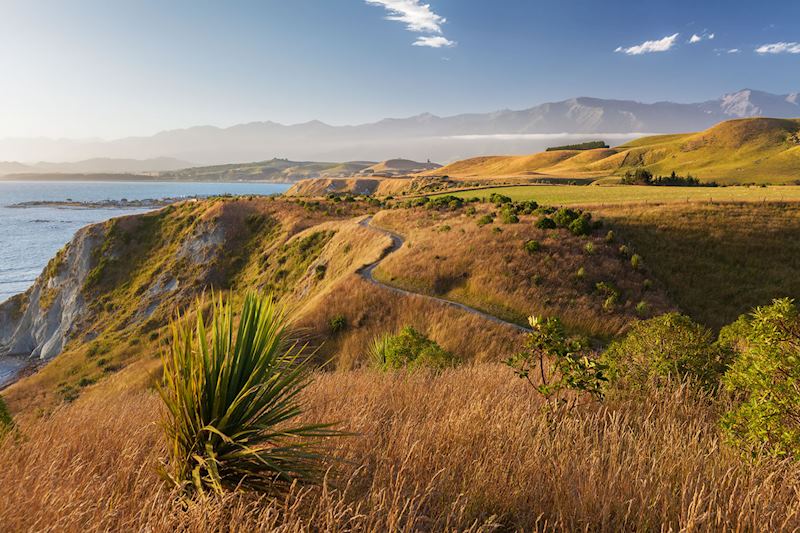
The morning began in song. In the grounds of an old pa (Māori settlement) on a mountainside overlooking the ocean, Maurice got out his guitar and began to strum. ‘Your turn,’ he said, fixing his gaze on me. We’d met barely an hour ago, pressing our foreheads and the tips of our noses together in hongi, a traditional Māori greeting representing an exchange of ha (the breath of life). Now, he wanted me to sing back the song he’d patiently taught me in Te Reo in his resonant, earthy voice. Stumbling a little over the sounds of the unfamiliar language, I took a deep breath and opened my mouth.
Here’s the thing about the more authentic Māori experiences on offer in New Zealand: sometimes, you have to be prepared to step a little out of your comfort zone. If you choose to spend a day with Maurice and his family in Kaikoura, my advice is to come open-minded and willing to take part in what may feel like very intimate, personal moments. And you may leave feeling that it was a privilege to do so.
Later, Maurice’s sister, Rebecca, walked me through native bush around the coastline, pointing out how the Māori used vegetation for medicinal properties or tracking. She took hold delicately of a fern, folding it over, ‘so other tribe members would know that someone had passed this way.’ Other plants such as kawakawa (Māori pepper tree), she explained, were used as natural Band-Aids or brewed in teas to cure sore throats.
Finally, we swung by Rebecca’s home to meet Maurice’s older daughter, who was the proud bearer of ta moko (face tattoos). She explained how the swirling whirlpool-like designs linked back to her family heritage.
Then, it was time for me to sing the song I’d learned that morning to the whole family — a crowd of young nieces and nephews appeared on cue.
Daunting? A bit, but they all knew the words, and so we sang together — a lovely reflection of how Māori traditions are truly multi-generational.
Start planning your trip to New Zealand
Start thinking about your experience. These itineraries are simply suggestions for how you could enjoy some of the same experiences as our specialists. They’re just for inspiration, because your trip will be created around your particular tastes.
View All Tours in New ZealandPlan your trip
Tell us about your plans and one of our specialists will plan a unique trip for you...
Make an enquiryRequest our brochure, The World Your Way

Order your digital copy via email.
Request a brochure