By Central Asia specialists Chris
In just a few days of travel along the Silk Road, you can find yourself moving from lush green mountain pastures to vast stretches of desert, passing through cities that boast some of the most arrestingly designed Islamic architecture you might ever set eyes on.
Your journey along this historic trade route isn’t about luxury — it’s about authenticity. The hotels here may not come with five-star polish, but they overflow with character and the kind of warm, genuine hospitality that leaves a lasting impression. For me, the dramatic landscapes and architectural treasures more than make up for any compromise on high-end comforts.
What was the Silk Road?
The Silk Road was a network of trading routes rather than one long road. Its roots stretch as far back as 207 BCE, when silk was first produced in China and transported for trade. It eventually grew to link Asia, the Middle East, and Europe, branching off into the Indian Subcontinent and Russia.
Silk Road trade didn’t stop at silk, though. Goods, from spices, teas, salt, and sugar to ceramics, ivory, jewels, and furs, were shuttled back and forth as demand increased for items produced across the world. Less tangible exchanges also took place: ideas, languages, cultural practices, and religions were passed on between traders, the effects of which you can encounter as you travel.
How to tackle the Silk Road
It would be a very long trip if you tried to cover the Silk Road in its entirety, so I suggest zooming in on Central Asia, taking in both Kyrgyzstan and Uzbekistan.
For me, it’s the most intriguing section, full of juxtapositions. You can go from mountains, lakes, and plains to wide-open desert. From lakeside yurt camps to spindly minarets, and from remote, rural experiences in Kyrgyzstan to age-defying architectural jewels in Uzbekistan.
The route I suggest starts off with a flight into Almaty, the former capital of Kazakhstan. You then cross overland into Kyrgyzstan for one of the most scenic drives of the trip (more on that shortly). From Kyrgyzstan, you’ll then journey westward across Uzbekistan, through the cities of Tashkent, Samarkand, Bukhara, and Khiva, from which you can make your homeward journey.
Below is a more detailed breakdown to give you a taste of what you might experience along the way.
Crossing overland from Kazakhstan to Kyrgyzstan
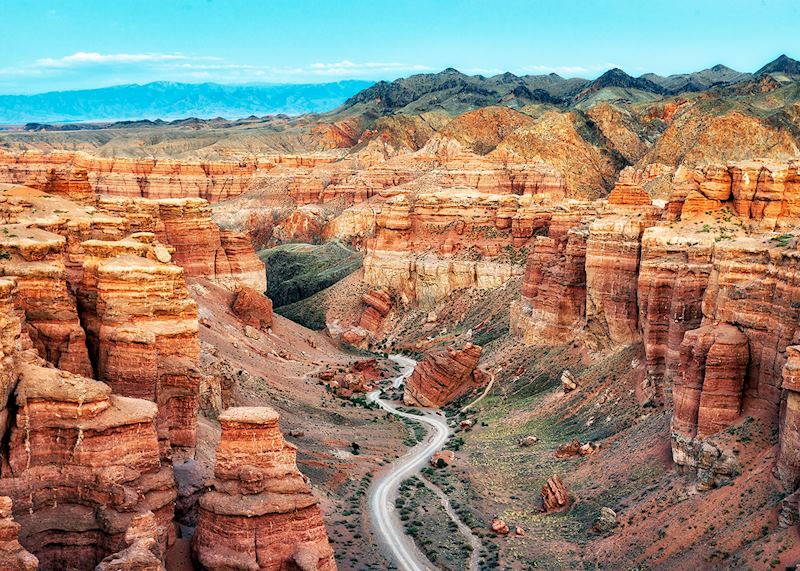
Almaty in Kazakhstan is your starting point — due primarily to its good accessibility to Kyrgyzstan. It’s a full-day drive that takes you through both bucolic hills and the snaking red-rock corridor of the Charyn Canyon, which looks, in places, like the USA’s Grand Canyon.
The border crossing over into Kyrgyzstan is unusually straightforward ― just a chain-link fence and a couple of officials sporting perhaps the biggest hats you’ve ever seen.
Kyrgyzstan: hiking, eagles, yurts & horses
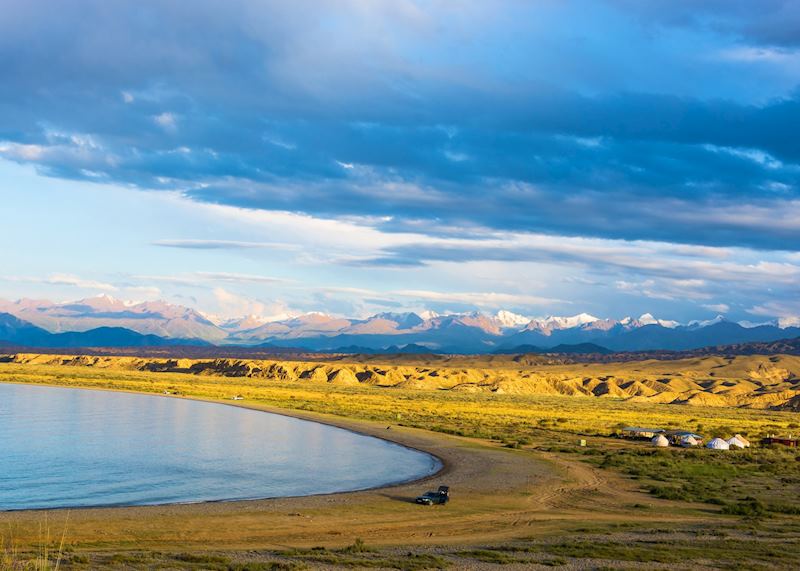
Vivid-green steppe grasslands, lake-filled alpine valleys, and sky-punching mountains… Kyrgyzstan has an untamed beauty.
Horses are a big part of life here, and you’ll see everyone astride them ― even toddlers. Hunting with eagles is also a local discipline, and we can arrange for you to meet the eagle hunters and perhaps even see them in action. You can also stay in a yurt camp, waking to a view over lakes and mountainsides.
Kyrgyzstan’s other calling card is its hiking. You might find yourself walking among wildflower meadows, snowy mountainsides, and glacially carved valleys ― and there’ll hardly be another soul in sight. Choose from long, challenging hikes or gentler half-day options, skipping some of the ascents by jumping in a 4x4. Guides will accompany you every step of the way and can shed light on the sights, fauna, and flora you see en route.
What to see in Uzbekistan: mosques, minarets & madrasas
Fly from Kyrgyzstan’s capital, Bishkek, to Tashkent, a city where centuries-old Islamic architecture rubs alongside vibrant modern buildings and Soviet-era tower blocks. As soon as you step off the plane, the topographical contrast with Kyrgyzstan is startling: you’re now on the edge of arid, flat desert.
As you explore, you’ll see that Uzbekistan offers a different kind of city experience, with lively pedestrian streets, illuminated landmarks at night, and plenty of restaurants to choose from.
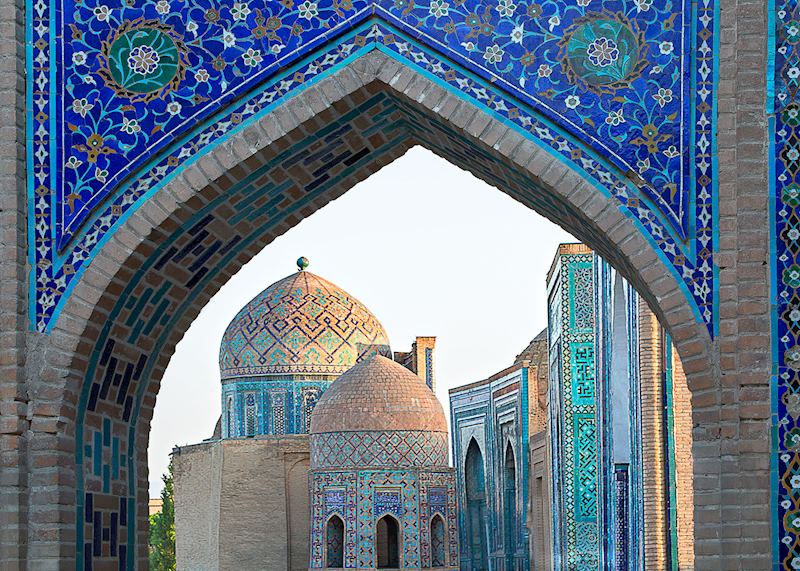
Uzbekistan is known for its intricately decorated mosques, madrasas (Islamic schools), and public squares. In places like Khiva, Bukhara, and Samarkand, their blue domes and patterned mosaics stand out against the surrounding sand-toned structures.
Some of the finest examples can be seen at Samarkand’s Registan, which you can visit by high-speed train from Tashkent. This centuries-old public square sits at the heart of the city and has played host to royal announcements, public executions, and important ceremonies over the years. It’s framed by three large madrasas: Tilya-Kori, Sher Dor, and Ulugbek.
During a privately guided tour, you can take in the madrasas’ towering minarets, rising on both sides, as well as their huge domes and archways that are symmetrically decorated with bright tiles. As you wander, your guide can point out the significance of the Sher Dor’s decoration: it uses images of tiger-like creatures, despite the general rule in Islam that living beings shouldn’t be depicted on religious buildings.
Make sure to return to the square at night, when local families come to mill about, and the madrasas are illuminated against the inky sky.
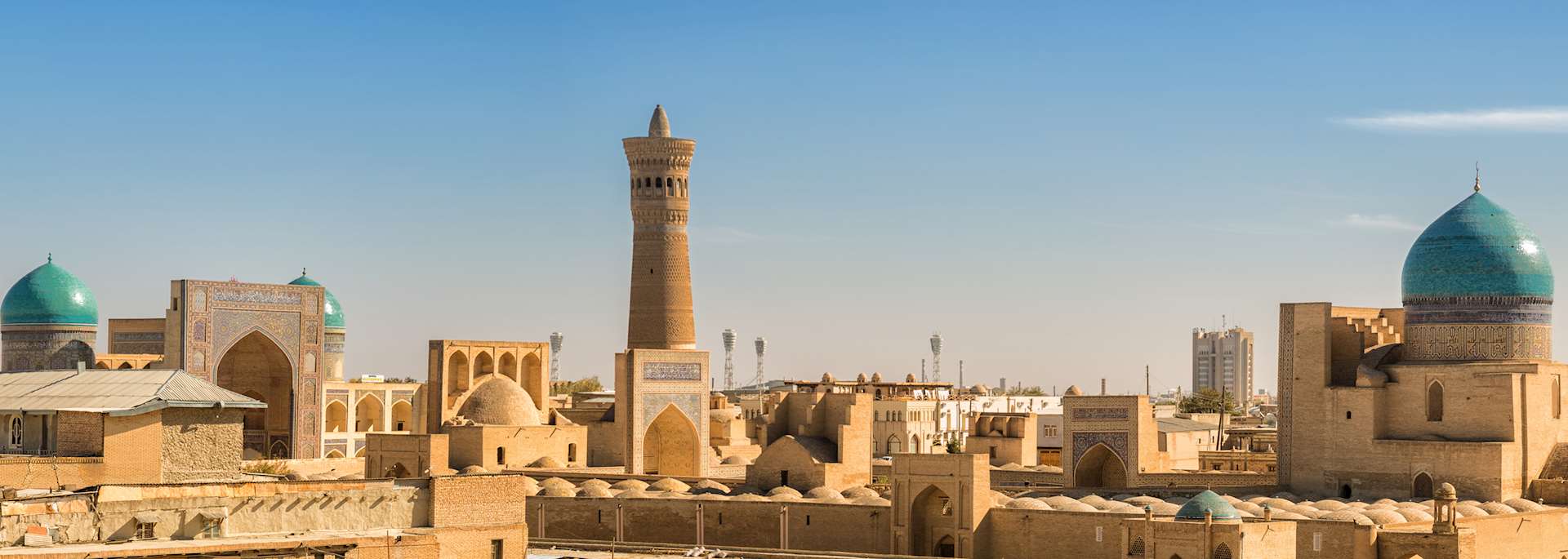
From here, you travel on to Bukhara, where you can climb the gigantic, still-intact portion of the Ark. This is a fortified citadel where British emissaries were executed during the years of the “Great Game” fought between the Russian and British empires in the 19th century. Then, nose your way through the maze of overspilling market stalls and ascend the Kalon Minaret for panoramas over the city.
Bukhara has a more languid feel than Samarkand, and you don’t have to wander far on foot to see unpaved gravel backstreets that look much like they did over 200 years ago.
Then it’s onto to Khiva, a city of (you guessed it) more madrasas and mosques. Here, they’re covered in elaborate majolica and azure patterns. While in the city, you might opt to have a privately guided tour to explore the walled old town of Itchan Kala, a fortified citadel of baked stone walls, now a UNESCO World Heritage Site oozing with Silk Road heritage. Or you could dive into the craft traditions of the city, wandering among the workshops of wood-carvers, ceramicists, embroidery artisans, metalworkers, and weavers.
From Khiva, you fly back to Tashkent to begin your homeward or onward journey.
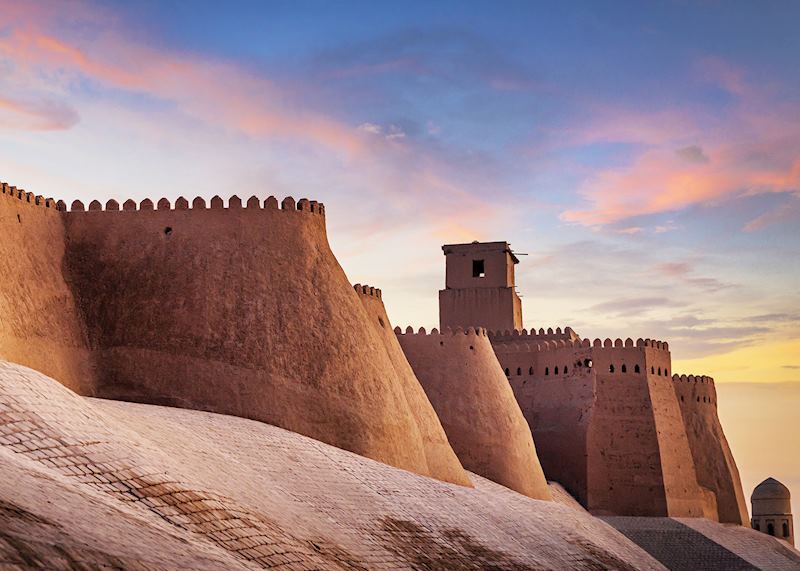
Best time to follow the Silk Road
You’ll be covering a vast area, so it’s hard to travel at a time when everywhere is at its best. I recommend taking a trip along the Central Asia portion of the Silk Road between April and early June or September and October, when it’s warm but not uncomfortably hot like it is between late June and August. That said, the cars you’ll travel in will all have air conditioning.
If you’re particularly interested in driving over the high-altitude passes in Kyrgyzstan, postpone your trip until June to avoid the spring snow.
Silk Road need-to-knows
The Silk Road does throw up particular challenges, but I’ll always try to make it as manageable as possible for you. That said, I think the rewards of experiencing this region more than make up for the small snags you might encounter while visiting it.
Here are some quirks to be aware of:
- Long journeys are part and parcel of a Silk Road trip. Some days you’ll spend seven or eight hours in a car. On the plus side, you’ll have private drivers, so you can spend your time gazing out of the window, taking in the shifting scenery.
- As well as lengthy car journeys, the trip also involves several regional flights and some journeys aboard Uzbekistan’s (thankfully efficient) rail network.
- During border crossings, you’ll sometimes have to contend with confusing paperwork and arcane bureaucratic formalities. Border guards can be officious, but I’ll make sure you have all the information you need ahead of your trip.
- Guides are generally not permitted to accompany you across borders, so you’ll have a different guide in each country, as is the case in many land borders across other parts of Asia. You might also have to walk with your luggage through no-man’s land when officially crossing into another country, but I’ll prepare you beforehand so you know what to expect and where.
- Despite the headaches of border crossings, travelers from the US can travel visa-free to Kazakhstan and Kyrgyzstan, although you'll need a visa to visit Uzbekistan.
- There aren’t modern, luxury hotels along the whole route, instead places to stay are a genuine mix. From traditional yurts beside remote alpine lakes to charming guesthouses in converted architectural relics, or stylish contemporary hotels with pools, rooftop bars, and shaded courtyards.
- Food is notably based around regional dishes and is traditionally meat heavy (so vegetarians might find it more challenging, though not impossible). Tasty local dishes to look out for include ashlan-fu (a spicy noodle soup served with giant potato fritters), plov (a rice and meat dish), fresh kebabs, and Uzbekistan’s ice cream — lighter, less sweet, and rooted in Soviet-era street culture. The bread is also a delight. Round, flat, and coated in sesame or poppy seeds, it’s often served warm, straight from the oven.
Despite these challenges, exploring Kyrgyzstan and Uzbekistan along the Silk Road offers you a deep connection to a rich cultural legacy. From diverse languages and cuisines to vibrant craftsmanship and traditions, you’ll encounter authentic hospitality, striking landscapes, and elaborate architecture, all woven into the fabric of this historic route.
Read more about trips to Central Asia
-
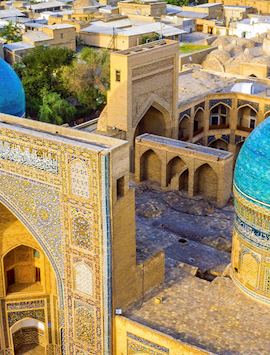
![Bukhara]()
-
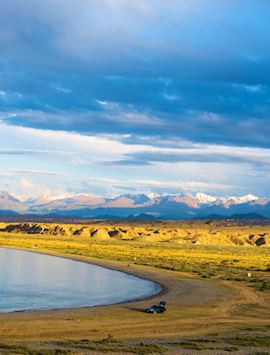
![Song-Kul Lake, Kyrgyzstan]()
Highlights of Central Asia: Kyrgyzstan's mountains & Uzbekistan's architecture
Uzbekistan and KyrgyzstanView this tour
Start thinking about your experience. These itineraries are simply suggestions for how you could enjoy some of the same experiences as our specialists. They're just for inspiration, because your trip will be created around your particular tastes.
Plan your trip
Tell us about your plans and one of our specialists will plan a unique trip for you...
Make an inquiryRequest our brochure, The World Your Way

Order your digital copy via email.
Request a brochure